Day 18
We focused today on writing our research paper through dissecting several saved sources--we spent most of the day doing this. On another note, Vardhman is waiting for a part to complete the stored water tank system but for now he is working on our database collection. In theory whenever the data is sent, it will be received by a computer, the data received will be stored in a .txt file which will be uploaded to the internet. We can then access water conditions remotely and "possibly" make corrections if anything were to go wrong with our controls.
We enjoyed a 4 day break for the 4th:)!
Monday, July 8, 2013

Tuesday, July 2, 2013
Day 17 RET summer training
Day 17
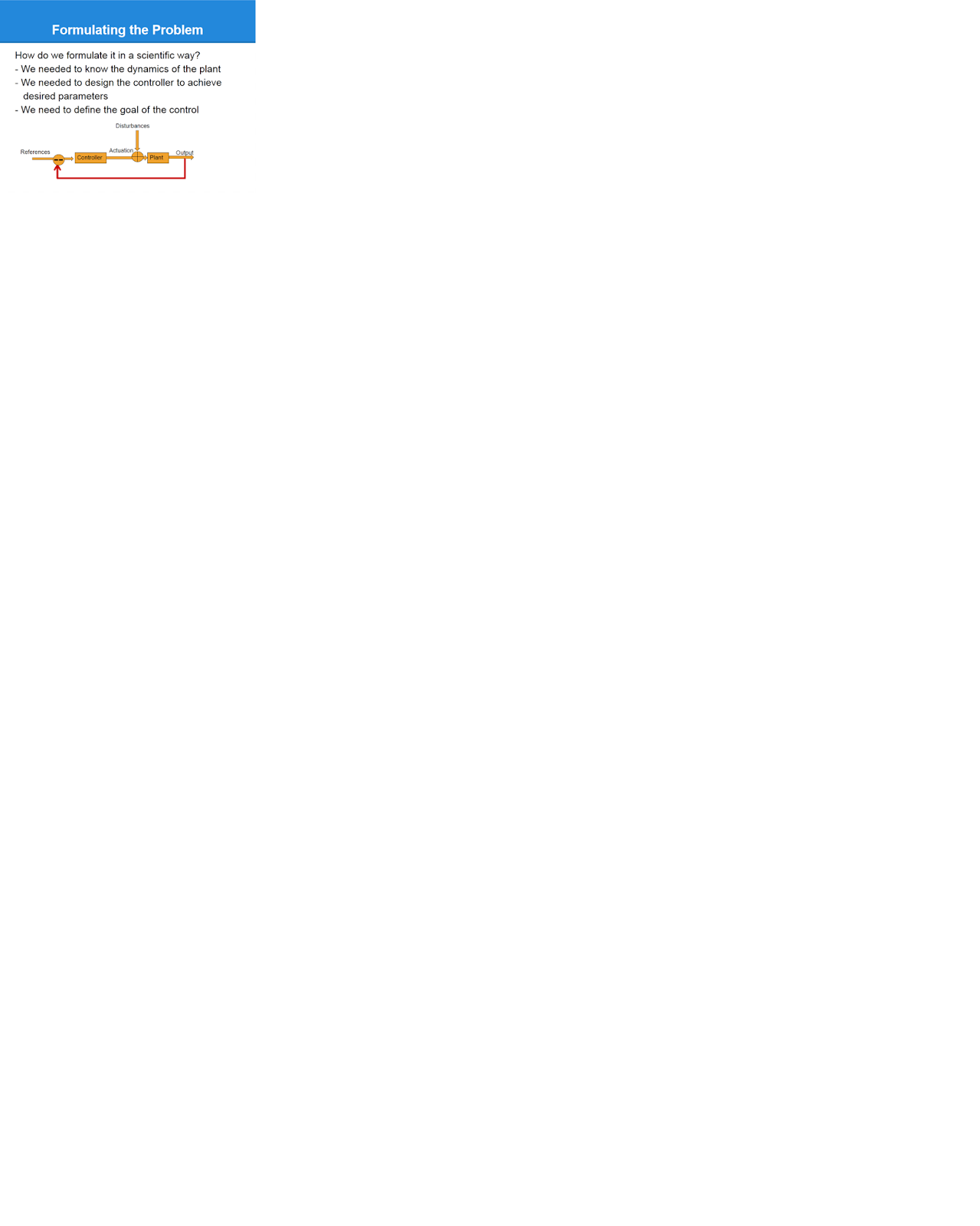
We started the day listening to a seminar by Dr. Wan over the second part of system control. The information was extremely useful as we are required to discuss how control plays a role in our aquaponic tank. The following info was obtained from Dr. Wan's lecture so will be slightly modified before our final presentation.


We started the day listening to a seminar by Dr. Wan over the second part of system control. The information was extremely useful as we are required to discuss how control plays a role in our aquaponic tank. The following info was obtained from Dr. Wan's lecture so will be slightly modified before our final presentation.


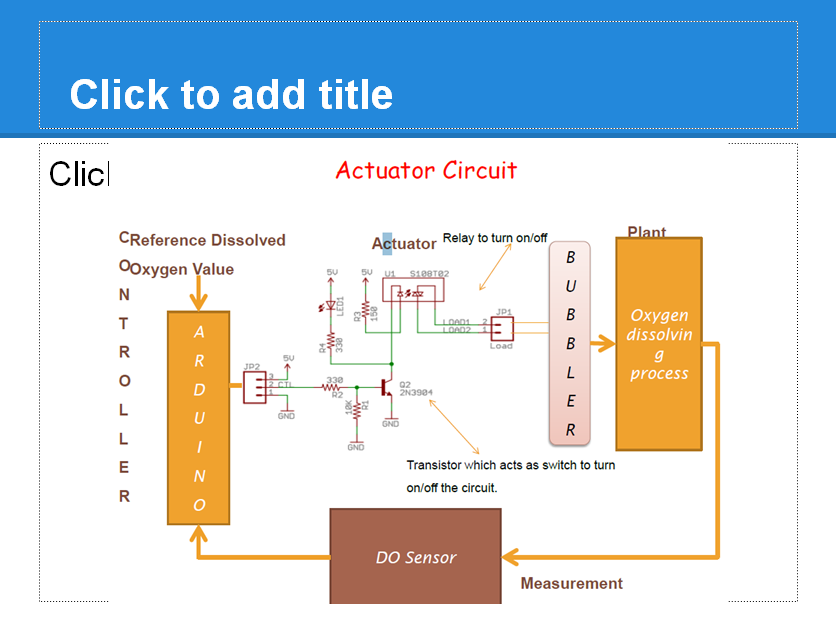
For the second part of the day we focused our attention on finalzing our food dispenser build, adding the 1/2" rubber tubing for water control tank, lesson plan development, and checking today's water conditions. As mentioned yesterday, our data collection has been pushed back and now until Monday of next week. We hope to deploy all systems and run it for a 24hr period. We will then add disturbances to a closed water system to observe controls stabilization at work. To test controls on pH we will take a small tank of water, add an acid, collect data; we will add a base respectively. For DO we will have water pump to a small tank, stop the pump (which will reduce DO levels), have our system take readings ("do it's thing") and see if it will turn on our circuit pump. Water volume control is a little trickier since we will have to remove water from our experiment small tank without disturbing and influencing the volume of water while arduino is collecting data. I'm not sure if I explained what we intend to do with water volume control. Essentially, using the same control/arduino package, we will control fish tank water volume using two sonars adhered to bottom part of lid. When fish tank water level falls 1/2" below bulkhead overflow, the controls circuit closes (allowing current) and pump turns on. We are making slight changes to our poster which completes the last requirement for our traning. I've included last year's poster to help serve as an example extension to what we create this year.

Monday, July 1, 2013
Day 16 RET summer training
Day 16
A quick dissection over our calendar and a short chat with Vardhman have changed our plans for monitoring and collecting data of our sensor cluster. The plan was to collect 24hr data today through a series of tweets (recall we receive tweets every 40min with a live update of water tank conditions for pH, temperature, and DO levels). There really is no problem with having all these tweets but we would like to be able to create an online database in which we can access live readings; then figuring out a way to graph these points to help us visualize the water conditions over a period of time. No biggie, we have more tasks to complete.
We took another trip to Lowe's to purchase a large container (which will house water to control system water level), 1/2" rubber tubing, pump for container, clamp, a third adhesive for pH dispenser, Velcro, lid to replace old existing one, and screws to mount motor. Fern took water readings this morning and noticed ammonia levels high once again. We decided to purchase 3 more plants to help with water conditions in addition to the existing growing bacteria. We now have 3 tomatoes and 3 cucumber plants:)
 The first series of pictures for food dispenser was just a prototype, I now used a 4 X 4 to mount motor to add stability. Using a drill press at ESSAT's workroom I carved out a 2 1/2" X 1" chunk to precisely insert motor. Next, I drilled a hole 1/2" deeper and one on top of wood to create a path through wood to allow us access to motor wires. Several strips of Velcro gave it both an aesthetic quality and a tight grip on the tank's lid. I need to remove blade motor screw to fit a small food container. Unfortunately I do not have such a small screw driver so have asked Vardhman for one. Placing container will finish off this task.
 The loctite adhesive from Friday did the trick in adhering solenoid to dispenser. We added water, left it in there for a couple hours and it does have a water tight seal.


A quick dissection over our calendar and a short chat with Vardhman have changed our plans for monitoring and collecting data of our sensor cluster. The plan was to collect 24hr data today through a series of tweets (recall we receive tweets every 40min with a live update of water tank conditions for pH, temperature, and DO levels). There really is no problem with having all these tweets but we would like to be able to create an online database in which we can access live readings; then figuring out a way to graph these points to help us visualize the water conditions over a period of time. No biggie, we have more tasks to complete.
We took another trip to Lowe's to purchase a large container (which will house water to control system water level), 1/2" rubber tubing, pump for container, clamp, a third adhesive for pH dispenser, Velcro, lid to replace old existing one, and screws to mount motor. Fern took water readings this morning and noticed ammonia levels high once again. We decided to purchase 3 more plants to help with water conditions in addition to the existing growing bacteria. We now have 3 tomatoes and 3 cucumber plants:)


Looks pretty awesome this time;)

The bottom tank on the far left is our water level control. The pump below this picture will pump water to fish tank (1st tier) when sensors (which will be attached under the lid) read levels below 1/2" of overflow bulk head in fish tank. We anticipate the addition of water, using a control, every 2 weeks. We will test control once Vardhman creates circuit (he will turn off/on the circuit-- no solenoid needed).

This motor is more powerful than our aquaponic system's.

Friday, June 28, 2013
Day 15 RET summer training
Day 15
We are officially half way into our training and what better way to end it but with a mid-term presentation. Our presentation took a little over 30 minutes including time for addressing questions from audience. I think we did very well. I've added our project next steps:
- Develop a device to measure ammonia levels autonomously
- Run the sensor cluster and PASCO for 24 hrs. to retrieve data
- Test efficiency of our aquaponic systems by measuring the success of our biotic factors..ie fish and
plants
- Create a water dispenser to help neutralize ammonia levels and to keep water levels stable
- Create our stream system from last year and deploy a control system for water level
- Add clams to system (act as a bio indicator)
- Build an online database
- Introduce a disturbance to tank and monitor
- taking video clips of automatic food dispenser and other controls at work
For access to our presentation, please follow the link below:
https://docs.google.com/a/metsa.nthls.com/presentation/d/1ylJSeqw-OU5MDI3nZeGVdD1Jp7L30d8oyK22HeZgKCA/edit?usp=sharing
Here is a video of our ebb and flow at work:)
http://www.youtube.com/watch?v=YnLG2Cbcnjs&feature=youtu.be
We have laid out a pretty solid calendar for next week.


We are officially half way into our training and what better way to end it but with a mid-term presentation. Our presentation took a little over 30 minutes including time for addressing questions from audience. I think we did very well. I've added our project next steps:
- Develop a device to measure ammonia levels autonomously
- Run the sensor cluster and PASCO for 24 hrs. to retrieve data
- Test efficiency of our aquaponic systems by measuring the success of our biotic factors..ie fish and
plants
- Create a water dispenser to help neutralize ammonia levels and to keep water levels stable
- Create our stream system from last year and deploy a control system for water level
- Add clams to system (act as a bio indicator)
- Build an online database
- Introduce a disturbance to tank and monitor
- taking video clips of automatic food dispenser and other controls at work
For access to our presentation, please follow the link below:
https://docs.google.com/a/metsa.nthls.com/presentation/d/1ylJSeqw-OU5MDI3nZeGVdD1Jp7L30d8oyK22HeZgKCA/edit?usp=sharing
Here is a video of our ebb and flow at work:)
http://www.youtube.com/watch?v=YnLG2Cbcnjs&feature=youtu.be
We have laid out a pretty solid calendar for next week.

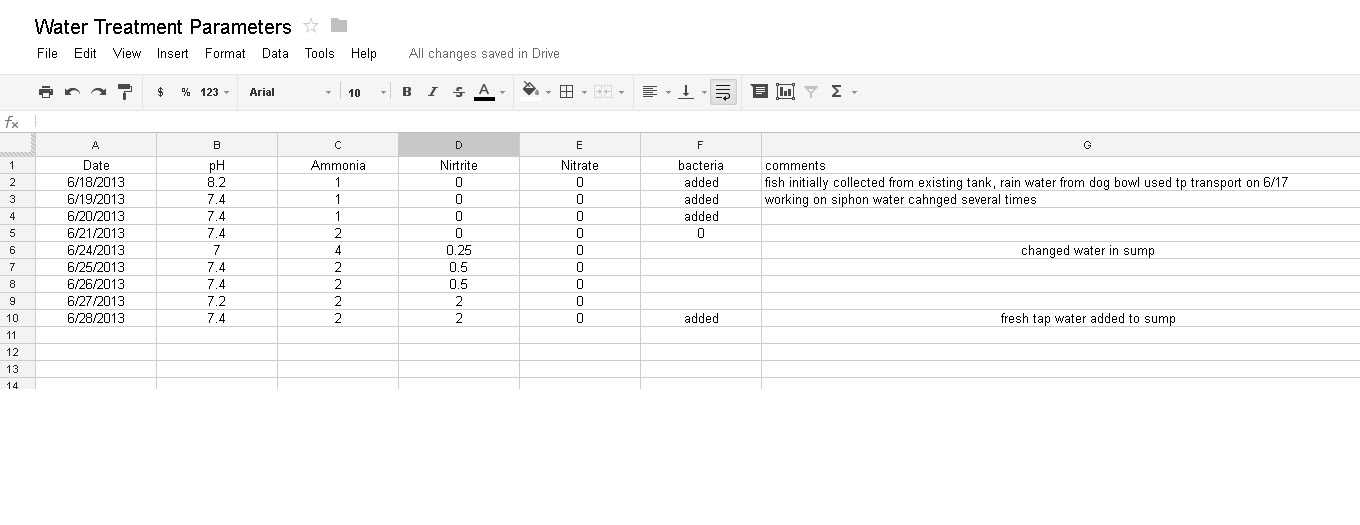
Fish water conditions:
Thursday, June 27, 2013
Day 14 RET summer training
Day 14
We left off yesterday with allowing for the adhesive to dry which will hold our solenoid and pH dispenser together. Vardhman came in this morning to drop sensors and to test both dispensers. We had some lickage problems with our pH dispenser; basically the threaded end of the solenoid isns't water or air tight. Obviously an air tight seal is very important as we are only trying to drop an approximate amount of solution to fish tank to neutralize (pH of 7-7.5) conditions. I used the loctite adhesion once more but a larger load--we will see.
The food dispenser works as intended. The food container rotates at 360o 4 times dispensing 10-15 food pellets. It will do this once a day in the morning. I will redesign the entire structure, including platform, as we do not need as large of a container. I will also find a more stable lid to replace the existing one.
Okay, so I think we have our ebb and flow functioning. The added 1/4" hose running out from syphon sleeve did the trick. It allowed for the correct pressure difference to exist between the times when tank is either full or completely drained. The plant bed drains and fills every 3 minutes. We think this will allow enough time for plant roots to get enough free O2 and receive enough H2O. We'll keep our fingers crossed:)
Dr. Wan invited her department students and us to a great lunch. This was a time for all of us to socialize and for us to share our project. They are all looking forward to tomorrow's presentation.


 We have a lower % error for all readings than what we hypothesized (5-10%) before beginning project. This is excellent!

Pic does not upload--will try later.
We left off yesterday with allowing for the adhesive to dry which will hold our solenoid and pH dispenser together. Vardhman came in this morning to drop sensors and to test both dispensers. We had some lickage problems with our pH dispenser; basically the threaded end of the solenoid isns't water or air tight. Obviously an air tight seal is very important as we are only trying to drop an approximate amount of solution to fish tank to neutralize (pH of 7-7.5) conditions. I used the loctite adhesion once more but a larger load--we will see.
The food dispenser works as intended. The food container rotates at 360o 4 times dispensing 10-15 food pellets. It will do this once a day in the morning. I will redesign the entire structure, including platform, as we do not need as large of a container. I will also find a more stable lid to replace the existing one.
Okay, so I think we have our ebb and flow functioning. The added 1/4" hose running out from syphon sleeve did the trick. It allowed for the correct pressure difference to exist between the times when tank is either full or completely drained. The plant bed drains and fills every 3 minutes. We think this will allow enough time for plant roots to get enough free O2 and receive enough H2O. We'll keep our fingers crossed:)
Dr. Wan invited her department students and us to a great lunch. This was a time for all of us to socialize and for us to share our project. They are all looking forward to tomorrow's presentation.


(added snokeling tube based off of Fox et al)
We compared PASCO versus arduino sensor cluster both in fish tank and using tap water. We tested tap water to compare DO levels to fish tank. Our data is shown below: 

Fern solved the problem of us "losing fish" to tank drainer. We hope no more fish will be lost:)Pic does not upload--will try later.
Day 13 RET summer training
Day 13
Vardham deployed sensor cluster once more late Tuesday evening. This morning Fern checked our ebb and flow and this system runs two cycles without our interference. This means, plant bed fills then drains, but fails to stop drainage after second fill. Fern has to literally turn off the valve coming from fish tank to allow it to stop draining. We will try one more change and if this does not work we will add a control.
The sensor cluster readings are right on target.


Vardham deployed sensor cluster once more late Tuesday evening. This morning Fern checked our ebb and flow and this system runs two cycles without our interference. This means, plant bed fills then drains, but fails to stop drainage after second fill. Fern has to literally turn off the valve coming from fish tank to allow it to stop draining. We will try one more change and if this does not work we will add a control.
The sensor cluster readings are right on target.


Wednesday, June 26, 2013
Day 12 RET summer training
Day 12
Not much going on today. Fern worked on the ebb and flow which we still can't seem to make it work. I worked on adhering the pH dispenser to solenoid and also, with Fern's help, touched up our presentation for Friday.
Not much going on today. Fern worked on the ebb and flow which we still can't seem to make it work. I worked on adhering the pH dispenser to solenoid and also, with Fern's help, touched up our presentation for Friday.
Subscribe to:
Posts (Atom)